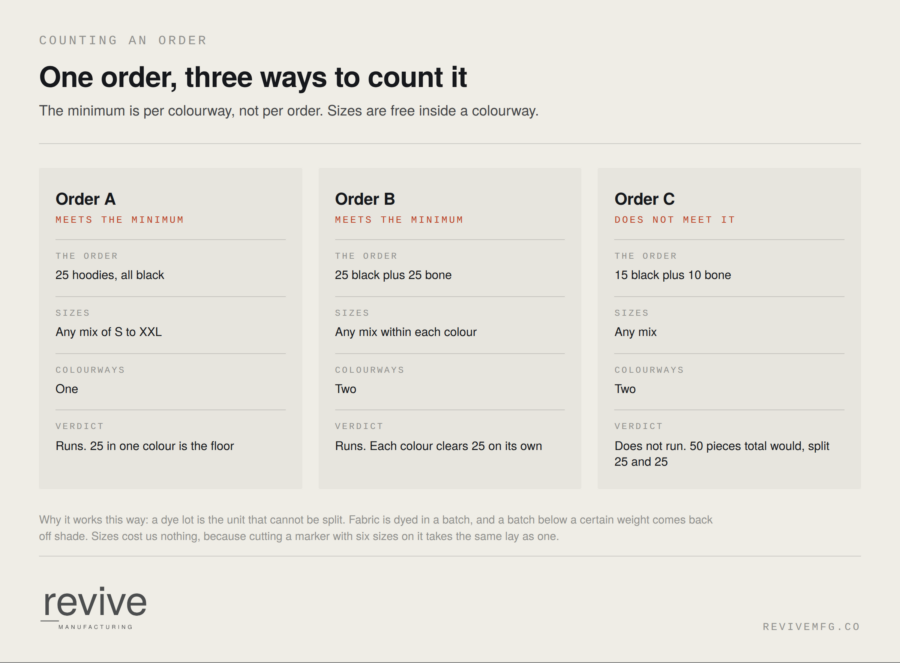
MOQ stands for minimum order quantity: the smallest number of units a factory will run. In apparel it is almost always counted per colourway rather than per order, and that single detail is where most first-time brands get caught out.
A factory quoting “MOQ 100” usually means 100 of each colour. Order black and bone and you have committed to 200 pieces, not 100. Nobody is lying to you. They just assume you already knew.
Why is MOQ counted per colourway and not per order?
Because the dye lot is the unit that cannot be split. Fabric is dyed in a batch, and a batch below a certain weight comes back off shade or comes back unevenly. The dyehouse has a floor, and that floor lands on you as a minimum.
Sizes are a different matter. Cutting a marker with six sizes laid on it takes the same fabric lay and the same cut as cutting one size, so a mixed size run costs the factory nothing extra. This is why our minimum is 25 pieces per colourway with any size mix you like inside it, and why a factory that also caps your sizes is adding a rule that has no cost behind it.
What actually drives a factory’s minimum?
Four things, in roughly this order of weight.
| Driver | What it forces | Can it be worked around |
|---|---|---|
| Dye lot | A floor on fabric weight per colour | Yes, by using a stock colour already being run |
| Line changeover | Setting up a sewing line costs the same for 25 pieces or 2,500 | Partly, by batching your styles together |
| Trim minimums | Woven labels, zips and custom cords have their own minimums, often 500 or 1,000 | Yes, order trims once and hold them across runs |
| Screen and plate setup | A screen print screen costs the same whether you print 25 or 1,000 | Yes, switch method. DTF and embroidery have no setup at low counts |
Notice that only the first one is really about fabric. The rest is setup cost, which is why low minimum quotes get expensive per unit rather than being refused outright.
What is a good MOQ for a clothing manufacturer?
There is no universal figure, but there is a useful way to read one. A published minimum is a sign the factory has thought about small orders. An unpublished minimum usually means it moves depending on how busy they are and how interested they are in you.
When we surveyed fourteen manufacturer websites ranking for these terms, five published any minimum at all and none published pricing. Several rank for “low MOQ” without stating a number anywhere on the site. That is not a small omission. It is the single number a buyer needs to decide whether to keep reading.
| Minimum per colourway | What it usually signals |
|---|---|
| 1 to 10 | Print on demand or an agent reselling blanks. Not a factory |
| 25 to 50 | A real factory that has decided to take small brands seriously |
| 100 to 300 | Standard for a mid-size line. Reasonable, but plan your cash |
| 500 and up | Built for established brands and retail programmes |
| Not published | Ask before you send a tech pack |
How do you get under a factory’s minimum?
Five approaches that work, and one that does not.
- Cut your colourways, not your quantity. One colour at 50 beats two colours at 25 each on every measure: cost per unit, lead time, and the amount of stock you are left holding.
- Take a stock fabric colour. If the mill is already running black, you are not triggering a dye lot at all. This is the biggest single lever and almost nobody asks for it.
- Batch your styles. A hoodie and a crew in the same fabric and the same colour share a dye lot and usually a line setup.
- Change the decoration method. Screen print punishes low counts. Embroidery and DTF do not.
- Buy your trims once. Order a thousand woven labels on the first run and carry them. Labels do not expire.
What does not work is asking a factory to break its dye lot as a favour. They can say yes, and the fabric comes back a shade off, and you will be the one who has to decide whether to accept it.
Is a low MOQ always better?
No, and this is worth being honest about. A low minimum costs more per unit. The setup does not get cheaper because your order got smaller, so the same setup is divided across fewer pieces.
What a low minimum actually buys you is not cheap product. It is the ability to be wrong without it ending you. Twenty five pieces in the wrong colourway is a lesson. Three hundred pieces in the wrong colourway is a cupboard you look at for two years.
That is the real argument for starting small, and it is a different argument from the one most low MOQ pages make.
What is the minimum at revive?
25 pieces per colourway. Any mix of sizes inside that colourway. It applies to hoodies, sweatshirts, tees, tanks, tracksuits, joggers, caps, beanies, jackets, socks, activewear and team kit.
Samples are 8 to 10 days. Bulk is 15 days from the day you approve the sample. There is no tier below 25 and no surcharge hidden behind it, because a minimum you have to negotiate is not really a published minimum.
We are not the cheapest factory you will find. What we are is predictable, and at 25 pieces predictability is worth more than the last few cents per unit.
Next: how long the whole thing takes, day by day, and what a first run actually costs you once duty and freight are in the number.
Tell us what you want made and we will tell you what it takes to run 25 of them.