A first clothing order takes about 30 days from enquiry to packed cartons, before shipping. Eight to ten days of that is your sample. Fifteen is bulk production. The rest is decisions, and the decisions are the part that actually slips.
Most factories quote you the sewing. The sewing is the reliable bit. What follows is the whole calendar, including the parts that are yours.
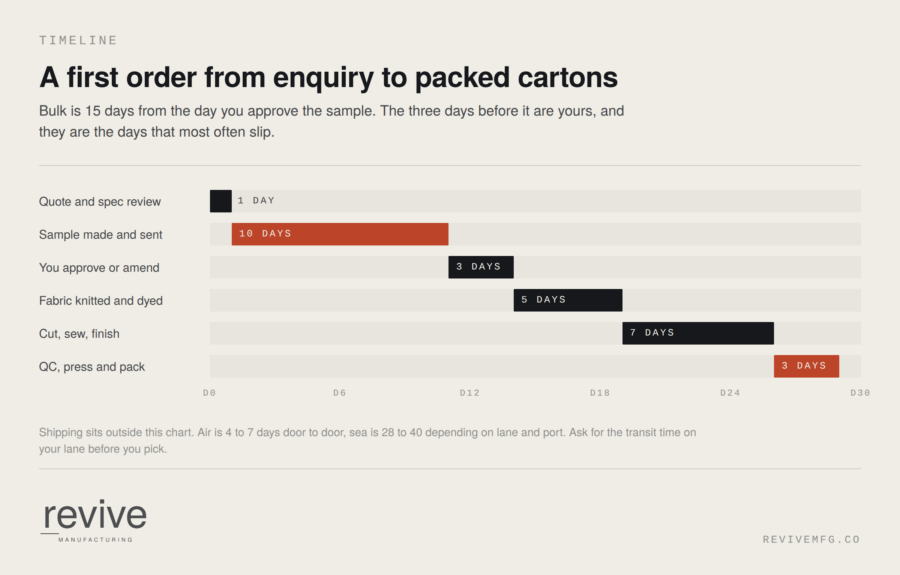
How long does clothing manufacturing take, step by step?
| Stage | Days | Who controls it | What is happening |
|---|---|---|---|
| Quote and spec review | 1 | Us | Reading your pack, pricing it, flagging what is missing |
| Sample | 8 to 10 | Us | Pattern, cut, sew, decorate, photograph, ship |
| Your approval | 1 to 5 | You | Wearing it, measuring it, deciding |
| Fabric knitted and dyed | 5 | Us | Dye lot run to your Pantone, relaxed, inspected |
| Cut, sew, finish | 7 | Us | Marker, lay, cut, bundle, sew, decorate, trim |
| QC, press and pack | 3 | Us | Measurement check, defect check, press, fold, polybag, carton |
| Shipping | 4 to 40 | Freight | Air is 4 to 7 door to door. Sea is 28 to 40 by lane |
Ten days for a sample rather than eight applies to jackets, socks and activewear, because those need more than one machine type set up before anything can be sewn.
Why is sampling not faster?
Because a sample is a one-off production run with none of the efficiency. A pattern gets drafted, a single lay gets cut by hand, one machinist sets up for one garment, decoration gets set up for one piece, and then somebody photographs it properly and gets it into a courier.
Factories quoting three day samples are usually doing one of two things: sending you an existing garment with your label in it, or skipping the pattern and sewing from a size chart. Both produce something in your hands quickly. Neither tells you what bulk will look like, which is the only reason to sample at all.
What actually moves the delivery date?
Almost none of it is the sewing.
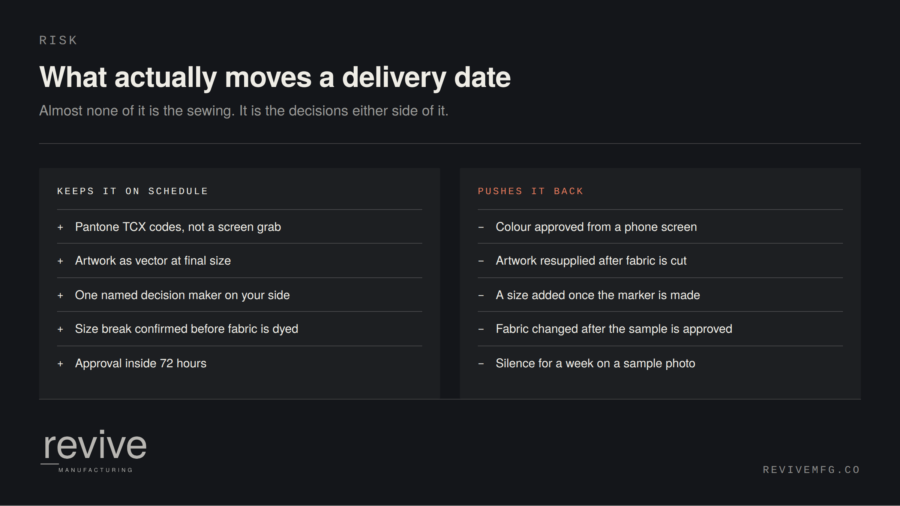
The single most common delay we see is colour approved from a phone screen. The fabric gets dyed to a Pantone that was never actually checked, the bulk arrives, and it reads differently to the person who ordered it. That is a re-dye, and a re-dye is five days plus the argument about who pays.
The second most common is a size added after the marker is made. A marker is the cutting layout, and adding a size after it is cut means cutting again on fabric that was bought to the original ratio.
The third is silence. A sample photo sent on a Friday and answered the following Thursday has cost six days that no amount of machinery gets back.
How do you plan a launch backwards?
Work back from the date you want stock on hand, not the date you want to announce.
| Weeks before launch | What should be done |
|---|---|
| Week 12 | Specification agreed, quote accepted, sample started |
| Week 10 | Sample in your hands. Wear it, wash it, measure it |
| Week 9 | Approved or amended. If amended, a second round starts here |
| Week 7 | Bulk in production. Colour and artwork are now locked |
| Week 5 | Bulk complete, QC passed, cartons packed |
| Week 4 | Air freight leaves, or sea freight left two weeks earlier |
| Week 3 | Customs cleared, stock received, counted against the packing list |
| Week 2 | Photography and product pages built from real stock |
| Week 0 | Launch |
Twelve weeks feels generous until you need a second sample round, and roughly half of first orders do. Build one in. A second round that you planned for costs ten days. A second round that you did not costs your launch date.
Can it be done faster?
Yes, in three specific ways, and no in every other way.
- Take a stock fabric colour. Removes the dye lot entirely, which is five days off the front of bulk.
- Approve the sample in 24 hours. Free. The most underrated lever available to you.
- Air freight instead of sea. Expensive per kilo, but it converts four weeks into one.
What cannot be compressed is the sample. A factory that agrees to skip it is agreeing to send your first proper garment to your customers.
What we commit to
Samples in 8 to 10 days. Bulk in 15 days from the day you approve. Minimum 25 pieces per colourway, any mix of sizes inside it.
We publish those numbers because they are the two figures a buyer needs and almost nobody in this industry states them. When we surveyed fourteen manufacturer websites, two published a sample turnaround and none published pricing.
We are not the fastest factory in the world and we are not the cheapest. We are specific about dates, and on a first order that is worth more than either.
Next: what to send so the first sample is right, and how minimums work if you are running more than one colour.
Tell us your deadline and we will tell you whether it is real.