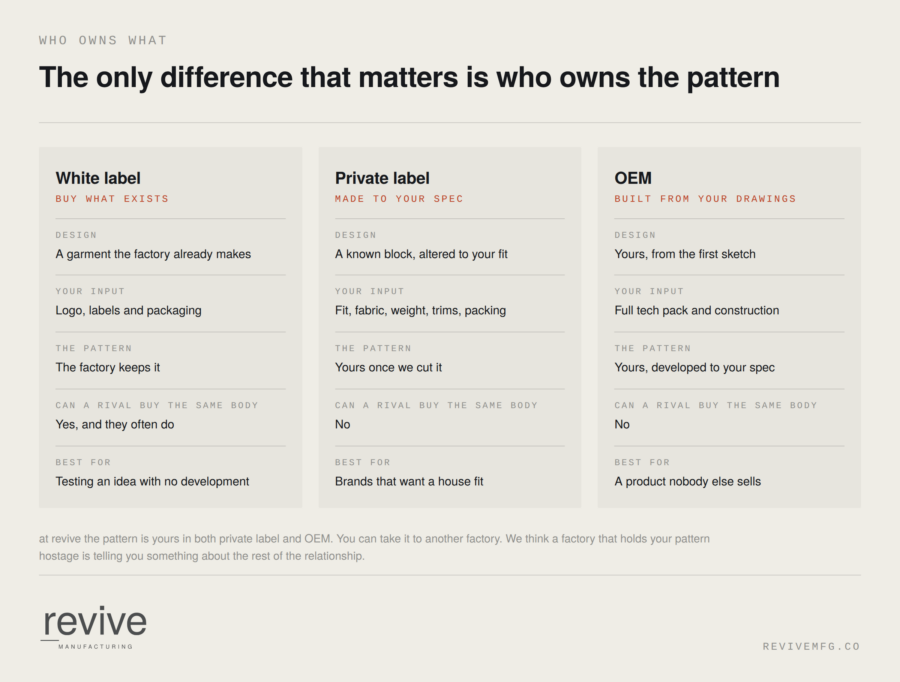
The difference between private label, white label and OEM comes down to one question: who owns the pattern. Everything else you have read about the three terms is downstream of that. White label means the factory owns it and sells the same garment to other people. Private label and OEM mean you own it, and nobody else gets that body.
The terms get used loosely, including by factories, so here is what each one actually gets you.
What is white label clothing?
White label means you buy a garment the factory already makes and put your brand on it. The blank exists before you arrive. You choose a colour from what is already running, add a woven label, a neck print and a hangtag, and it ships.
You are not designing anything. You are relabelling. That is not an insult, it is a strategy, and it is the right one when you want to find out whether anybody will buy from you before you spend on development.
The trade-off is that the garment is not yours. The same body, the same fit, the same fabric is available to anyone else who walks in. If your product is doing well, a competitor can order it next week.
What is private label clothing?
Private label means the factory makes a garment to your specification, and the result belongs to you. We start from a known block, a pattern that already fits properly, then change what you want changed: the body length, the shoulder drop, the fabric weight, the ribbing, the trims, the labels, the packing.
The pattern that comes out the other side is yours. Nobody else gets that fit. You did not pay for a full development cycle and you did not start from nothing, but the garment is specific to your brand.
This is where most brands should be. It is the middle path, and the reason it is the middle path is that starting from a working block removes most of the ways a first sample goes wrong.
What is OEM in clothing manufacturing?
OEM, original equipment manufacturer, means the factory builds your product from your drawings. You bring the design, the construction, the measurements and the tolerances. We bring the pattern making, the sourcing and the line.
In apparel the term is used a little differently from electronics, where it originated. In practice it means: no existing block, full development, your intellectual property from the first sketch.
You will also see ODM, original design manufacturer. That is the opposite arrangement. The factory designed it, you buy it and brand it. ODM and white label are near enough the same thing from where you are standing.
Private label vs white label vs OEM: a straight comparison
| White label | Private label | OEM | |
|---|---|---|---|
| Starting point | A garment that already exists | A proven block, altered to your spec | Your drawings, nothing else |
| You control | Labels, packaging, colour from stock | Fit, fabric, weight, trims, packing, colour | Everything, including construction |
| Who owns the pattern | The factory | You | You |
| Can a rival buy the same body | Yes | No | No |
| Development needed | None | One sample round, usually two | Two to four rounds, sometimes more |
| Time to first sample | Stock, or a labelled sample in days | 8 to 10 days | Longer, and it depends on the design |
| Minimum at revive | Not offered | 25 pieces per colourway | 25 pieces per colourway |
| Best for | Testing demand before you commit | Building a house fit you keep | A product that does not exist yet |
Which one should you actually choose?
Pick by the question you are trying to answer, not by the tier that sounds most serious.
| If this is true | Start here | Because |
|---|---|---|
| You have an audience but no proof they will buy | White label | Spend on the test, not the pattern |
| You sold a first run and people asked for a different fit | Private label | The fit is the thing they are asking you to own |
| Your product needs a construction nobody sells | OEM | No block will get you there |
| You are pitching a retailer who asked for exclusivity | Private label or OEM | You cannot promise exclusivity on a shared body |
| You need 300 units in three weeks for an event | White label | Development does not compress |
| Your margin is thin and returns are killing you | Private label | Returns are usually a fit problem, and fit is a pattern problem |
Most brands that come to us asking for OEM actually want private label. They want a garment that is theirs, and they assume that means starting from a blank page. It does not. Starting from a blank page mostly buys you extra sample rounds.
What does each one cost you in time?
Money differs by garment, fabric and quantity, so any number quoted here would be fiction. Time is the cost you can plan around, and it is the one factories are vaguest about.
At revive, a private label sample is 8 to 10 days from an approved specification. Ten days rather than eight for jackets, socks and activewear, because those need more than one machine type to be set up. Bulk is 15 days from the day you approve the sample. OEM adds development rounds on the front of that, and how many depends entirely on how complete your tech pack is.
White label has almost no lead time on the garment and all of its lead time on the decoration, which is worth knowing before you promise a date.
Questions to ask before you commit to a factory
Whichever tier you pick, these four answers tell you more than a capability deck will.
- Who owns the pattern after the first bulk order? If the answer is not “you”, you are in a white label arrangement being sold as private label.
- What is the minimum, and is it per style or per colourway? A factory quoting “100 pieces” without saying which usually means 100 per colour, which is a different business.
- How many days to a sample, and how many to bulk after approval? Two numbers. If you get a range that spans a month, they are quoting the queue, not the process.
- What happens if bulk does not match the approved sample? The answer should exist before you need it.
How revive works
We do private label and OEM. We do not do white label, because we do not keep a catalogue of our own garments to sell you.
The minimum is 25 pieces per colourway, and sizes inside a colourway are free to mix. Samples are 8 to 10 days, bulk is 15 days from approval. The pattern is yours, and you can take it somewhere else, which we would rather say out loud than have you find out by asking.
We have made garments for more than 500 brands and none of them are ours. That is the whole business.
Next: what MOQ means and why it is counted per colourway, and what a tech pack needs to contain before you ask anyone for a price.
Send us what you want made and we will tell you which of the three it is.