Finding a clothing manufacturer is not the hard part. Telling a factory from a middleman is. Most of what you will find searching is a trading company, a sourcing agent or a marketplace listing, and all three describe themselves in exactly the same language a factory uses.
You can sort them with eight questions, none of which require a factory visit or a lawyer.
Where do you actually look?
| Source | What you get | Worth your time when |
|---|---|---|
| Search, directly | Factories with their own site and their own numbers | Always. Start here |
| Marketplaces | Volume, and a mix of factories and resellers | You are mapping what exists, not choosing |
| Instagram and LinkedIn | Floor footage and real work in progress | You want to see the line before you write |
| Trade shows | Face to face, samples in hand | You are past the shortlist stage |
| Another brand’s label | The country of origin, at least | You already know a garment you want matched |
| Sourcing agents | A shortlist and someone local | You have budget and no time |
The neck label on a garment you admire is the most underused lead in this industry. It will not name the factory, but it names the country, and it tells you the fit you want already exists somewhere.
Eight questions that sort a factory from a middleman
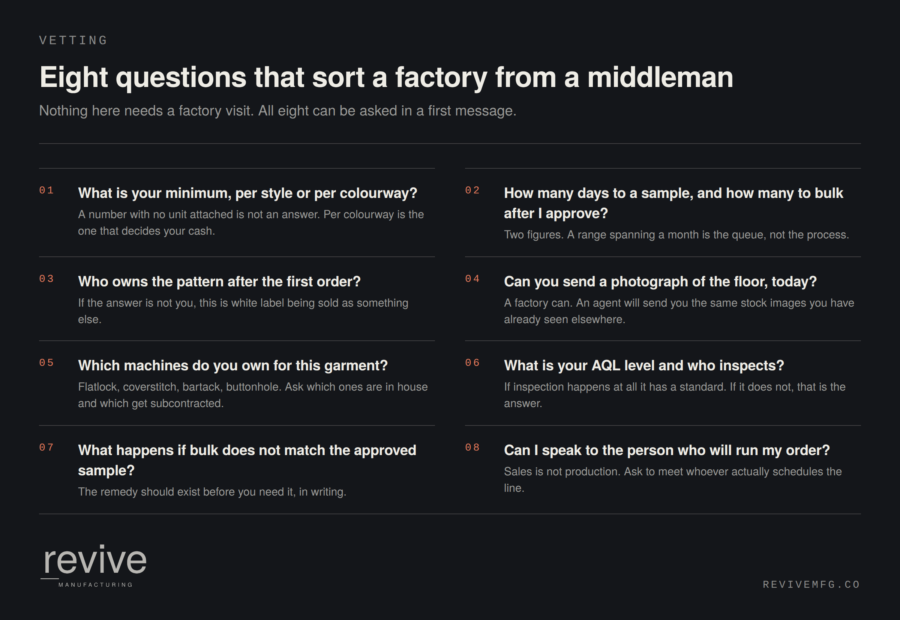
Send them as a list. How the reply is written matters as much as what it says.
- What is your minimum, and is it per style or per colourway? A number with no unit is not an answer. Per colourway is the version that decides your cash.
- How many days to a sample, and how many to bulk after I approve? Two separate figures. If you get one range spanning a month, you are being quoted the queue.
- Who owns the pattern after the first bulk order? If the answer is not you, this is white label being sold as private label.
- Can you send a photograph of the floor, taken today? A factory can do this in an hour. An agent sends you images you have already seen on three other sites.
- Which machines do you own for this garment? Flatlock, coverstitch, bartack, buttonhole, kansai. Ask which are in house and which get subcontracted. Subcontracting is normal. Not knowing is not.
- What is your AQL level, and who inspects? If inspection happens, it has a standard attached to it. If the question confuses them, that is your answer.
- What happens if bulk does not match the approved sample? The remedy should exist before you need it, and it should be in writing.
- Can I speak to the person who will schedule my order? Sales is not production. The gap between the two is where most orders go wrong.
What are the red flags?
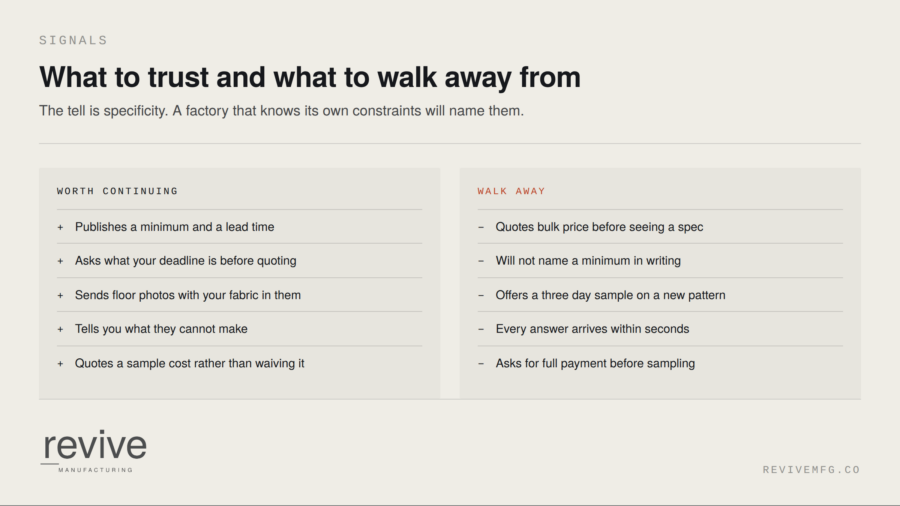
Four worth spelling out.
A bulk price before they have seen a specification. The price of a garment lives in its construction. Anyone quoting before they know the construction is quoting something else and will revise it later, at which point you have already committed.
A three day sample on a new pattern. Either they are sending you an existing garment with your label sewn in, or they are sewing from a size chart without drafting a pattern. Both arrive fast. Neither tells you what bulk will look like.
No minimum stated anywhere. When we surveyed fourteen manufacturer websites ranking for these terms, five published a minimum and none published pricing. Several rank for “low MOQ” without a number anywhere on the site. An unpublished minimum usually means it moves with how busy they are.
Replies that arrive in seconds, always. Somebody who answers a fabric question instantly has not asked the knitting floor. Good answers sometimes take a day, and the ones that take a day are usually the true ones.
How do you check a factory without visiting?
Five things you can do from where you are sitting.
- Ask for a video call from the floor, not from an office. Ask them to walk past the cutting table and the finishing line. You are not inspecting, you are confirming the floor exists.
- Ask for a sample of something they already make. Not your garment, theirs. It arrives faster and it tells you about their finishing standard immediately.
- Check the same numbers on every page of their site. Contradictions are the cheapest tell there is. One manufacturer we surveyed claims 3,000 brands on one page and 8,000 on another, and quotes both two to three weeks and four to six weeks for the same process.
- Ask a question you already know the answer to. Something specific about a fabric or a stitch. You are testing whether the person replying has access to somebody who knows.
- Pay for the sample. A free sample sounds generous and removes the only real commitment either side has made. Paying puts you in a queue rather than in a pile.
Should you use a factory in your own country?
It depends on what you are optimising for, and it is worth being clear about the trade rather than patriotic about it.
| Domestic | Offshore | |
|---|---|---|
| Unit cost | Higher, sometimes much | Lower |
| Minimums | Often lower | Varies. Ours is 25 per colourway |
| Lead time to your door | Days | Production plus 4 to 40 days freight |
| Duty and customs | None | Real, and set by fibre content |
| Fabric choice | Narrower, more imported anyway | Wider, mills are next door to the factory |
| Visiting | Easy | A trip |
The honest version: most of the fabric in a domestic garment was imported anyway. What you are really buying domestically is speed and the ability to drive over. Those are worth paying for on a repeat programme and rarely worth it on a first run.
Who we are, since you are vetting
We are a factory in Pakistan making private label and OEM apparel for brands in the US, the UK and the EU. Minimum 25 pieces per colourway with any size mix. Samples in 8 to 10 days. Bulk in 15 days from the day you approve. The pattern is yours and you can take it elsewhere.
We have made garments for more than 500 brands and none of them are ours, which is why you have not heard of us.
Ask us the eight questions. If the answers do not hold up, ask somebody else them too.
Next: the four routes to a factory compared, and what to send once you have picked one.