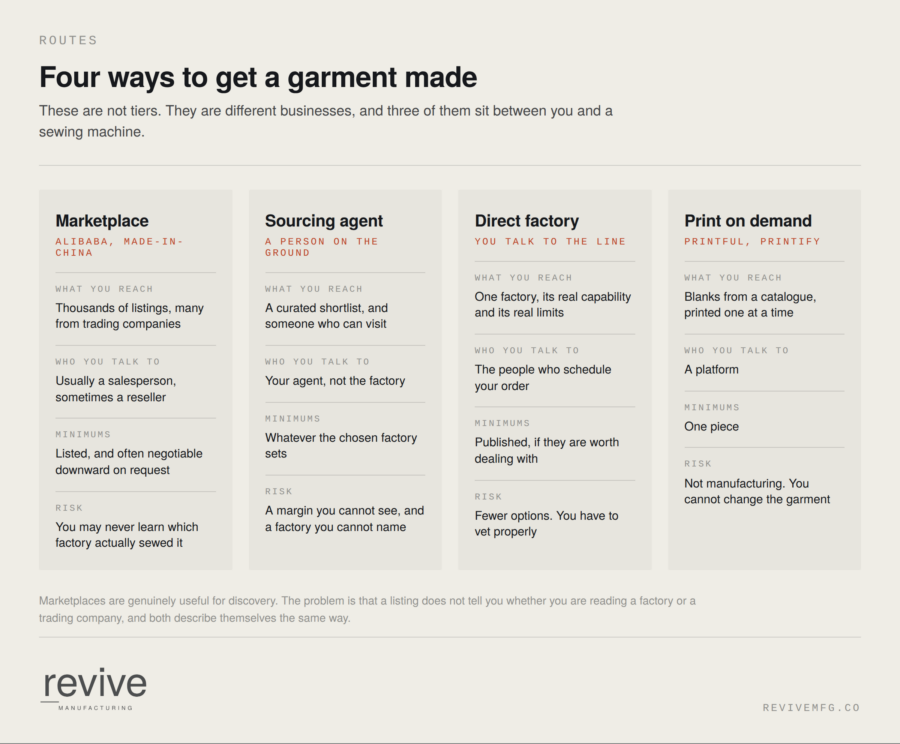
There are four routes to getting a garment made, and three of them put somebody between you and a sewing machine. Alibaba is not a bad tool. It is a directory, and the problem with using a directory as a supplier is that a listing cannot tell you whether you are reading a factory or a trading company, because both write themselves up the same way.
Here is what each route actually is.
What is wrong with Alibaba for clothing?
Nothing, if you use it for discovery. The trouble starts when you use it as a procurement channel.
Three specific problems. First, you usually cannot tell a factory from a trading company, and a trading company subcontracts your order to a factory you never learn the name of. If the second run comes back different, you do not know which link changed. Second, the minimums shown are often negotiable in a way that tells you they were never real, which makes every other number on the page suspect. Third, gold supplier status and trade assurance are commercial products. They mean somebody paid for a badge and there is a dispute process. They do not mean anybody inspected the sewing.
Used as a list of who exists, it is genuinely useful. Used as the whole process, you end up managing a supply chain you cannot see.
What are the actual alternatives?
| Route | Who you are really talking to | What it hides | Good for |
|---|---|---|---|
| Marketplace Alibaba, Made-in-China, IndiaMART | Usually a salesperson, sometimes a reseller | Which factory sews it | Discovery and price sense |
| Sourcing agent | Your agent | Their margin, and the factory’s name | You have budget and no time |
| Direct factory | The people who schedule your order | Nothing, if they publish their numbers | Anything you intend to repeat |
| Print on demand Printful, Printify | A platform | That it is not manufacturing | Testing designs at zero stock risk |
| Domestic small-batch | A local workshop | That much of the fabric is imported anyway | Speed, and being able to drive over |
| Wholesale blanks plus a decorator | Two separate suppliers | That you cannot change the garment | Merch and events |
How do you tell a factory from a trading company?
Four questions. Trading companies are not dishonest, but they answer these differently because they have to.
- “Which machines do you own for this garment?” A factory names them. A trading company talks about partners.
- “Send a photo of my fabric on your floor this week.” A factory takes one. A trading company has to ask somebody else and it takes days.
- “What can you not make?” A factory has a list and gives it to you. A trading company can make anything, because it is sourcing rather than sewing.
- “Who will schedule my order?” A factory has a name. A trading company has a process.
None of this makes a trading company the wrong choice. If you need twelve different products from six factories, that is precisely what they are for. It makes them the wrong choice for one product you intend to repeat, because every repeat depends on a link you cannot see.
Is print on demand a real alternative?
It is a real business and it is not manufacturing. You are printing on a blank from somebody else’s catalogue. You cannot change the fit, the fabric weight, the construction, the trims or the labels beyond a neck print.
It is the correct tool for exactly one job: finding out whether anybody will buy your design before you put money into stock. Do that first if you have not sold anything yet. It is cheaper than being right for the wrong reason.
What it cannot become is a brand with a product of its own, because the garment is not yours and never will be. The moment your customers start describing the fit as the reason they buy, you have outgrown it.
When should you go direct to a factory?
When any one of these is true.
- You intend to reorder the same garment more than once
- The fit matters enough that you would change it
- You are pitching a retailer who has asked about exclusivity
- Your returns are a fit problem rather than a demand problem
- You want the pattern to be an asset you own
The catch with going direct is that the vetting is now your job. Nobody is filtering for you. That is the whole trade: you remove the margin and the ambiguity, and you take on the diligence.
What going direct looks like here
You write to us, or send a photo on Instagram. We tell you what it would take to make it, what we would change, and what we cannot do. Minimum is 25 pieces per colourway with any mix of sizes. Sample in 8 to 10 days. Bulk in 15 days from the day you approve it. The pattern is yours afterwards, including if you take it to another factory.
We publish those numbers because the survey we ran across fourteen competitor sites found five publishing a minimum, two publishing a sample turnaround and none publishing pricing. The numbers are the thing buyers need, and withholding them is a choice.
We are not the cheapest. We are specific, and on a first order specificity is worth more.
Next: the eight questions that sort a factory from a middleman, and where to manufacture, and what it costs to land it.