A tech pack is the single document a factory builds your garment from. It is not a mood board and it is not a design. It is a specification: every measurement, every material, every stitch and every label, written down so that the person cutting the fabric does not have to guess.
Here is the part nobody tells you. If a section is missing, the factory does not stop and ask. It fills the gap with whatever is normal for that factory, and you find out at sample stage. Half of what people call a bad sample is actually an incomplete tech pack meeting a reasonable assumption.
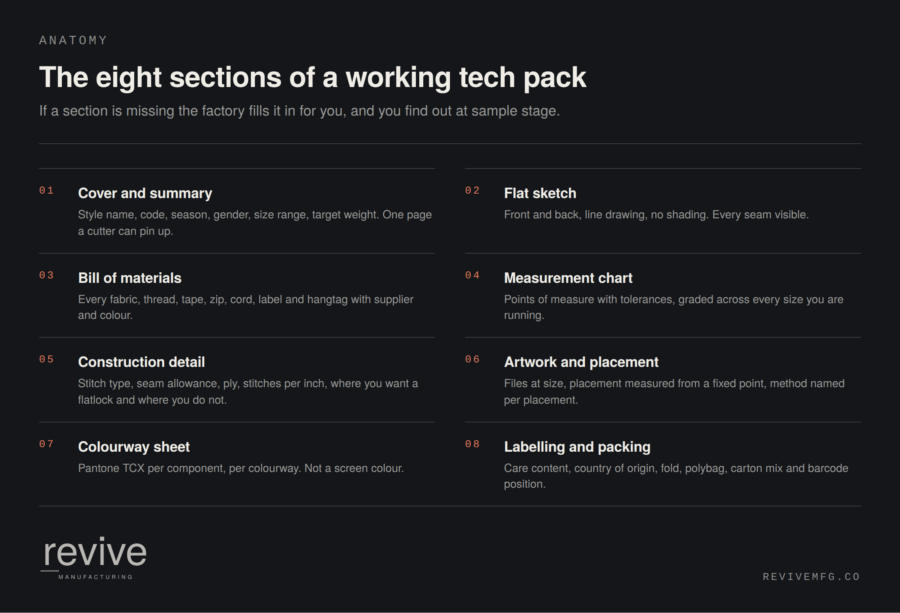
What goes in a tech pack?
Eight sections. In a good one they fit on eight pages.
1. Cover and summary
Style name, style code, season, gender, size range, target fabric weight, target market. One page someone can pin above a cutting table. If your style code appears in three different formats across the pack, that becomes a question, and questions cost days.
2. Flat sketch
Front and back, drawn as flat line art with no shading, no model and no rendering. Every seam visible. A photograph of a garment you like is useful context, but it is not a flat, because a photograph hides the back and hides the seams.
3. Bill of materials
Every component, listed: shell fabric, rib, lining, thread, drawcord, eyelets, zip, tape, woven label, care label, hangtag, polybag. Each with a supplier or a reference, a colour, and a position. The BOM is where most cost sits, and it is the section most first packs leave half empty.
4. Measurement chart
Points of measure with tolerances, graded across every size you intend to run. Chest, body length from high point shoulder, shoulder width, sleeve length, armhole, cuff width, hem width, hood height. Name the points the same way on every page.
Tolerance matters more than people expect. A chest measurement with no tolerance means the factory applies its own, usually half an inch either way, and at that point your small and your medium start to overlap.
5. Construction detail
Stitch type, seam allowance, ply, stitches per inch, and which seams you want overlocked, flatlocked, coverstitched or bound. This is the section that decides whether the garment feels cheap, and it is almost always the section left blank.
6. Artwork and placement
Files supplied at final size, in vector where possible. Placement measured from a fixed point, normally down from the high point shoulder and across from centre front. “Chest, centred” is not a placement. “90mm down from HPS, centred on CF, 180mm wide” is.
Name the method per placement too, because the same artwork screen prints and embroiders very differently.
7. Colourway sheet
Pantone TCX references per component, per colourway. TCX is the textile set, on cotton. TPX and TPG are the paper and plastic sets, and a colour that looks right on paper can land noticeably off on fabric.
Never approve a colour from a screen. Every screen you own is lying to you in a slightly different direction.
8. Labelling and packing
Care content, fibre composition, country of origin, size label position, fold method, polybag type, how many pieces to a carton and in what size ratio, barcode position. If you are shipping to a retailer, their packing manual overrides everything here, so send it.
What happens when a section is missing?
| Missing section | What the factory assumes | What you get back |
|---|---|---|
| Tolerances | Its house tolerance | Sizes that overlap at the edges |
| Stitch and seam detail | The fastest construction on the floor | A garment that fits but feels thin |
| Fabric weight in GSM | Whatever is closest in stock | A hoodie 60g lighter than the one you pictured |
| Pantone TCX codes | A match to your screenshot | A colour you cannot repeat next season |
| Placement measurements | Centred by eye | A print that drifts between sizes |
| Packing | Bulk polybags, assorted carton | A retailer chargeback |
Do you need a tech pack to get a quote?
No, and any factory that insists on one before it will talk to you is filtering out the people it should be helping.
You can get a usable quote from five things: the garment type, the fabric and weight, the quantity, the number of colourways, and the decoration method. That is enough to price a hoodie within a workable range.
What you cannot get without a tech pack is a reliable quote, because the price of a garment lives in the construction, and the construction lives in section five.
What if you do not have one?
Send a photograph of a garment that fits you the way you want yours to fit, plus your artwork, plus the quantity. That is a real starting point and we work from it regularly.
Then we build the pack with you during sampling, which is what sampling is actually for. The sample is not a preview. It is the thing that turns a description into a specification.
A checklist to send with your first enquiry
- Garment type and a reference photo, front and back
- Fabric and target weight in GSM, or the name of a garment whose weight you want
- Size range and how many of each size
- Number of colourways, with Pantone TCX codes if you have them
- Artwork as vector, with the width you want it printed
- Decoration method per placement, or ask us to recommend one
- Quantity per colourway
- Your delivery deadline and your destination country
That list takes twenty minutes to put together and it removes roughly a week of back and forth.
How it works with us
Send whatever you have. We quote from it, sample in 8 to 10 days, and the tech pack gets built properly during that round rather than before it. Bulk is 15 days from the day you approve. Minimum is 25 pieces per colourway.
The finished pack and the pattern are yours to keep, including if you take them somewhere else.
Next: how to pick a fabric weight so section three stops being guesswork, and what the calendar looks like once you approve.