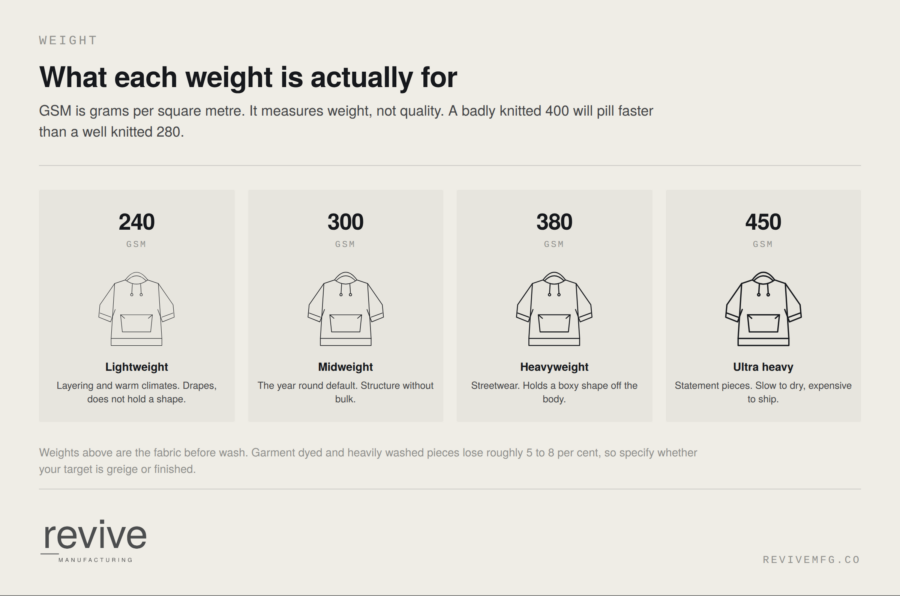
GSM means grams per square metre, and for hoodies the usable range runs from about 240 to 500. Most brands should be somewhere between 300 and 380. Below 280 you get a sweatshirt that behaves like a long sleeve tee. Above 450 you get a garment that is expensive to ship and slow to dry.
The important thing first: GSM measures weight, not quality. A badly knitted 400 will pill in a month. A well knitted 280 will outlive it. Weight tells you how the garment will sit on a body, and nothing else.
What GSM should a hoodie be?
Between 300 and 380 for most brands. Here is what each band does.
| GSM | Feels like | Use it for | Watch out for |
|---|---|---|---|
| 240 to 270 | A heavy long sleeve tee | Layering, warm climates, summer drops, resort | Drapes rather than holds shape. Prints can show through |
| 280 to 320 | The hoodie most people own | Year round core product, corporate and team kit | Nothing. This is the safe default |
| 330 to 400 | Structured, stands away from the body | Streetwear, boxy fits, premium positioning | Needs a wider pattern or it reads as tight |
| 420 to 500 | Outerwear that happens to be a hoodie | Statement pieces, cold climates, limited runs | Shipping cost, drying time, and shrinkage risk |
If you are launching and you are not sure, run 320. It photographs as substantial, it wears in most of the year, and it does not commit you to a fit that only works boxy.
Is a higher GSM hoodie better?
No. Heavier is heavier. That is all it is.
Three things go wrong when brands chase the number. First, heavyweight fabric needs a different pattern. A 400 GSM body cut on a 280 GSM block sits badly, because the fabric no longer follows the body and the armhole fights you. Second, heavy fleece takes a long time to dry, which customers notice more than you would think. Third, weight is chargeable. A 450 GSM hoodie costs meaningfully more to air freight than a 300, and on a 25 piece run that lands on your unit cost.
The only honest reason to run 400 plus is that the product is about being heavy. If it is, say so on the product page, because otherwise you are paying for something nobody can see in a photograph.
Loopback, brushed fleece and french terry: what is the difference?
The weight tells you how much fabric there is. The construction tells you what it feels like against skin, and it matters at least as much.
| Construction | Inside face | Behaves | Typical weight |
|---|---|---|---|
| Loopback, also called french terry | Uncut loops | Breathable, dries fast, softens with wear, holds print well | 240 to 400 |
| Brushed back fleece | Loops raised into a soft nap | Warmest, softest on day one, pills soonest | 280 to 500 |
A note on the names. Loopback and french terry are used interchangeably across the trade and both mean uncut loops on the inside face. Some suppliers draw a distinction between them and no two agree on what it is, so do not rely on the word. Specify uncut loop or brushed and you have said the thing that matters.
Loopback at 380 and brushed fleece at 380 weigh the same and feel nothing alike. If you specify only the number, you have specified half of it.
A note on brushed fleece: it is the one customers love in the shop and complain about after ten washes. Brushing drags the loop open into loose fibre ends, and loose ends are what migrate to the surface and ball up. Long staple cotton, a tighter knit and a proper shearing pass after brushing all slow it down. Cheap open-end yarn accelerates it.
Does cotton content change the weight you need?
It changes how the weight behaves. 100 per cent cotton at 320 feels heavier than an 80/20 cotton polyester blend at the same 320, because cotton fibre is denser and the blend carries more air.
Blends also shrink less and hold colour better through washing. Pure cotton has the better hand and the better wear-in. There is no correct answer, only a trade you should make deliberately.
One thing that is not a matter of taste: in the United States, fibre content changes your duty rate. A cotton hoodie enters at 16.5 per cent and a man-made fibre hoodie at 32 per cent, and classification follows whichever fibre weighs the most in the fabric. An 80/20 cotton polyester blend is cotton for tariff purposes and takes the lower rate. A 50/50 has no majority fibre at all, so a different tiebreaker applies and it lands on the man-made fibre line. If you are importing to the US, give your blend to a customs broker before you approve the fabric, not after.
Greige weight or finished weight?
Ask which one you are being quoted, because the two are not the same and the gap runs in both directions.
Greige weight is the fabric off the knitting machine, before dyeing and finishing. Finished weight is what arrives. Finishing changes it: scouring and enzyme washes take weight out, while compacting pulls the fabric in and pushes grams per square metre up. Which way a given fabric moves depends on the finishing route, so nobody can tell you a universal percentage. What we can tell you is that two quotes for “400 GSM” regularly come back feeling different, and this is why.
Put the word finished in your tech pack next to the number and the ambiguity disappears.
What to write in your specification
Six lines, and your fabric is properly specified.
- Weight and whether it is greige or finished, for example 340 GSM finished
- Construction: uncut loop (loopback or french terry) or brushed back fleece
- Fibre content by percentage, for example 80 per cent cotton, 20 per cent polyester
- Yarn type if you care about pilling: ring spun or combed, not open-end
- Rib composition and weight for cuffs, hem and hood opening
- Wash and finish: enzyme, silicone, garment dyed, or none
What we run
Hoodies and sweatshirts from 240 to 500 GSM in loopback and brushed back fleece, in cotton and cotton blends. The weight bands in the table above are the ones we actually run, not an industry standard, because no industry standard exists. Minimum is 25 pieces per colourway with any mix of sizes. Samples in 8 to 10 days, bulk in 15 days from approval.
If you send us a hoodie you already like, we will weigh it and tell you what it actually is, which is usually faster than deciding from a chart.
Next: how to write the rest of the specification, and how minimums are counted if you want two weights in the same run.